
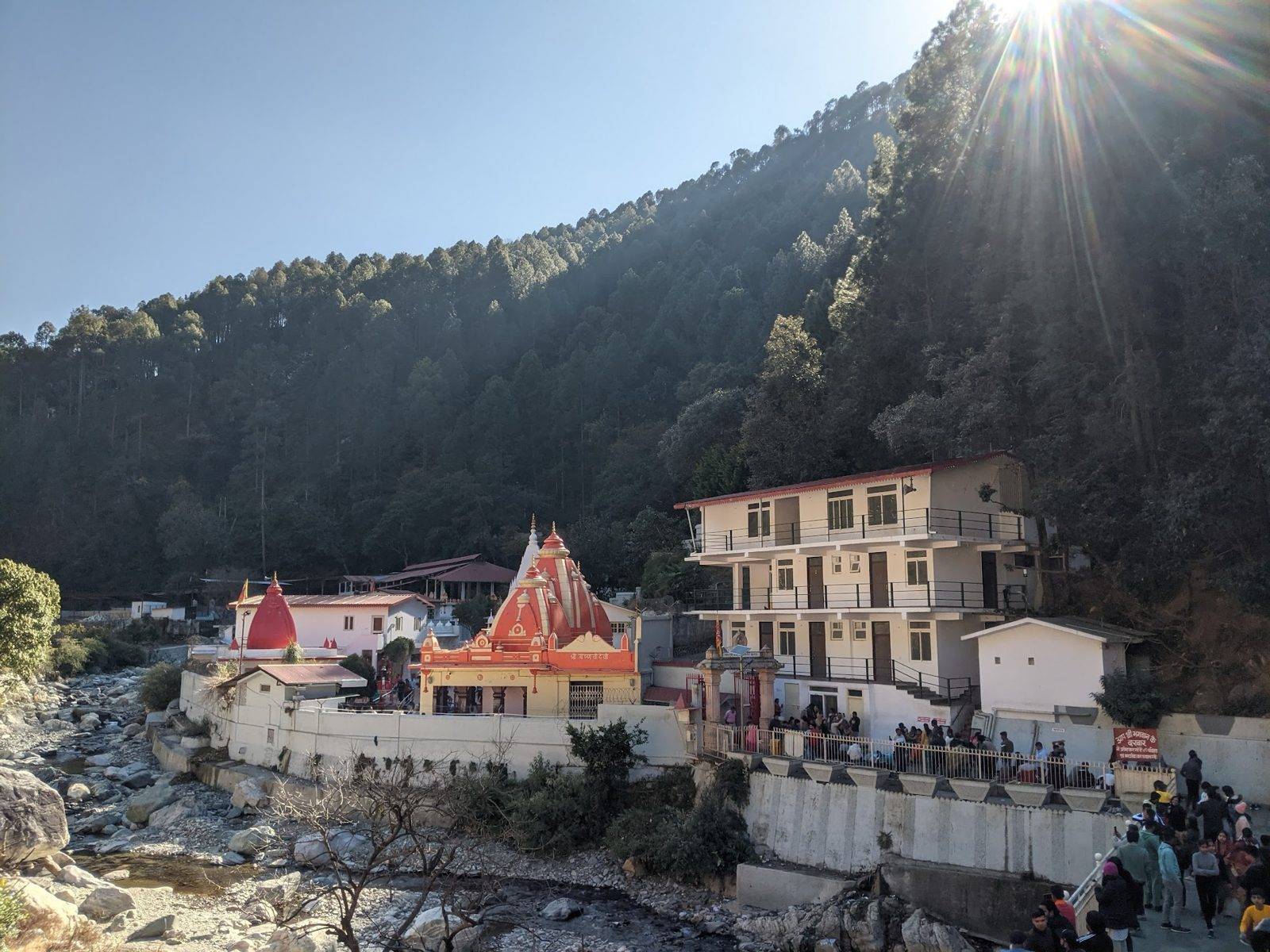
Kainchi Dham on an early morning, which is the temple the film is named for and the one place in it the film never actually visits. Photo by 25 Cents FC via Wikimedia Commons, licensed under CC BY-SA 3.0.
A Rs 2 crore film that opened to empty halls and passed Rs 100 crore in a month. What is in it, what the critics said, where it does and does not touch Kainchi Dham, and where to watch it in Haldwani.
The short version: Hanuman Ansh is a Hindi film about the early life of Neem Karoli Baba, released on 7 August 2026. It opened to almost nobody, about Rs 10 lakh on its first day, then grew on word of mouth into one of the most profitable Indian films on record: roughly Rs 100 crore gross in 30 days against a budget reported at between Rs 1 crore and Rs 2 crore. The critics who reviewed it gave it 3 to 3.5 stars and called it sincere rather than slick. It was shot in Chitrakoot, not at Kainchi Dham, and this first part ends before Baba ever reached Kumaon. In Haldwani it is playing at Laxmi Cineplex on Rampur Road, with more shows a short drive away in Rudrapur. Kainchi Dham itself is 49 km up the Bhowali road, and September is its quietest month of the year.
By Meghna Bora, Contributor, Nainital. About the author ↓
The facts first, because the numbers in circulation for this film change by the day and a good part of what is written about it online is fan copy.
| Item | Detail |
|---|---|
| Title | Hanuman Ansh, Hindi, with Braj and Bundeli subtitles in some prints |
| Subject | The early life of Neem Karoli Baba, from a boy called Lakshman Das in Braj to the sadhu of the train story. Part one of a planned trilogy. |
| Writer and director | Vishal Chaturvedi, a doctor turned filmmaker, adapting his own book Divine Detour: That Changed My Life |
| Cast | Shobhinaw Satyaa as Baba, Vihaan Shedge as the young Lakshman, with Chandan K Anand, Purnima Tiwari and Anil Rastogi |
| Released | 7 August 2026 in India, after a postponement from 31 July. Overseas release announced for 11 September 2026. |
| Runtime and certificate | 2 hours 30 minutes, CBFC U |
| Budget | Reported at Rs 2 crore by Sacnilk and at a little over Rs 1 crore by the director in a Variety India interview. Either way, tiny. |
| Box office | About Rs 103 crore gross and Rs 87 crore net in India by day 30, per Sacnilk, still running |
| Distributor | Cinepolis India, sole distributor, with Panorama Studios for the Delhi and UP circuit |
| Filmed at | Chitrakoot in Uttar Pradesh, plus Mumbai. Not at Kainchi Dham. |
| OTT | None announced as of 6 September 2026 |
This is the part people are actually talking about, so it is worth being precise about it. The figures below are Sacnilk's India net estimates, which is the tracker most of the press quotes. Producers' figures tend to run higher and the Wikipedia infobox was still showing Rs 42 crore when we checked, so treat any single number as approximate.
| Week | India net | What happened |
|---|---|---|
| Week 1 (7 to 13 Aug) | Rs 1.08 crore | Day one was about Rs 10 lakh across 355 shows at 10 percent occupancy. Almost no publicity, no known faces. |
| Week 2 | Rs 0.40 crore | Cut to about 30 shows a day. Occupancy in those few halls climbed to 74 and 85 percent over the weekend, which is the first sign of what came next. |
| Week 3 | Rs 10.40 crore | Shows rebuilt from 133 to 1,847 a day. Third Sunday alone did Rs 2.2 crore. |
| Week 4 | Rs 61.00 crore | Over 7,000 shows a day by the Thursday. Fourth Sunday Rs 12.75 crore. Sacnilk calls it the second biggest fourth week a Hindi film has ever had. |
| Day 29, 5th Friday | Rs 10.00 crore | Reported as the biggest fifth Friday for any Hindi film on record. |
| Running total, day 30 | Rs 87 crore net, Rs 103 crore gross | Still adding roughly Rs 5 to 10 crore a day at the time of writing. |
Read that table again and notice the shape. Most films earn most of what they will ever earn in their first weekend. This one earned about one percent of its first month in its first week. The screen count went from roughly 250 at release, down to about 40 in week two, and up past 2,000 by the start of September once Cinepolis took the film national. That curve is word of mouth and nothing else, because the makers had no money to buy it any other way.
On the question people mean when they ask about a film's success rate: on a budget of Rs 2 crore and a net of Rs 87 crore, the return is somewhere around forty times cost, and climbing. Sacnilk's own reporting puts it among the highest returns on investment in Indian cinema. The director has also said a large streaming platform turned the film down before production because it was only interested in stories about corrupt godmen, which is the detail that turns a box office story into a slightly better one.
Formal reviews are thin, because the film released with so little noise that most critics did not attend. The ones that exist agree with each other more than they disagree.
| Outlet | Rating | The verdict, in a line |
|---|---|---|
| DNA India, Simran Singh | 3.5 / 5 | Imperfect filmmaking, but Baba's journey moves you. An honest, humble attempt with unknown faces. |
| Deccan Chronicle | 3 / 5 | Encourages introspection and calm. Too long, and the editing could be crisper. |
| Film Information, trade review | No stars | Fairly well made, Satyaa acts very well, but the single-track screenplay drags and it will find few takers. Written on release day, and wrong about the last part. |
| Jagran and News18 Hindi | Not stated | Both reviewed it warmly, praising the simple treatment and the lead performance. We could not load either page to confirm a star count. |
| Rotten Tomatoes | No score | Only one critic review logged and fewer than fifty audience ratings, so no meter either way. |
The pattern is consistent: a modest, sincere film that critics rated as competent and audiences rated as something else entirely. The gap between a three-star review and a Rs 100 crore run is the story here, and it says more about who the film is for than about whether it is good. If you go expecting a devotional experience you will get one. If you go expecting a tightly cut biopic you will notice the 150 minutes.
Early twentieth century, in Braj. A thirteen-year-old boy called Lakshman Das loses his mother and leaves home, convinced that the only way back to her is through the divine. What follows is not a story of renunciation so much as of a boy trying to find Ram through Hanuman.
He arrives at a Vaishnav temple in Rajkot where the old Mahant, played by Anil Rastogi, recognises something in him and tests him. The boy declines comfort and praise and eventually leaves without a word, which the film treats as its first lesson: that a religious institution can be its own kind of bondage. Years of wandering follow, meditating under trees, sleeping by rivers, living on what people give. In one episode the villagers assume he has drowned because he has been underwater so long.
The set piece everyone remembers is the train. Now twenty-five, Lakshman boards a first-class carriage without a ticket and is put off at a small station by a British official. The train will not move. The engine is checked, the brakes are checked, nothing is wrong, and nothing happens until he is invited back on board. He agrees on two conditions, that no sadhu in India be thrown off a train for want of a ticket again, and that a station be built there for the villagers. The station is Neeb Karori, in what is now Farrukhabad district, and it is where the name Neem Karoli Baba comes from.
That is roughly where part one closes. The film's title is its thesis: by devotion to Hanuman, the boy becomes Hanuman Ansh, a portion of Hanuman, and the film spends its running time earning that claim through acts of feeding and service rather than through spectacle. The teaching the film keeps returning to is the one his devotees still repeat: love everyone, serve everyone, remember God.
If you are reading this on a Haldwani hotel site, this is the section that matters, and it starts with a correction to what a lot of people assume.
The film was not shot at Kainchi Dham. Principal photography was in Chitrakoot in Uttar Pradesh, in November 2025, with some work in Mumbai. The opening scene was filmed at an ashram there, and the Hanuman idol installation and Baba's cave were built as sets. Nothing in the film was photographed in the Kainchi valley.
Kainchi Dham is also not in the story. Part one covers Baba's childhood in Firozabad and his youth. He founded the Kainchi ashram in 1964, decades after the train episode, so the Kumaon years belong to a later film. The director has said part two will cover the Agra and Mathura periods, which still leaves Kainchi for a third.
What Kainchi did get was the launch. The film's poster was taken to Kainchi Dham for blessings at the very start of 2026, before going on to the samadhi at Vrindavan, and that is the connection the publicity has leaned on ever since. It is a real connection, but a ceremonial one.
None of this makes the temple less relevant to the film. It makes the film a reason to see the temple. Since the release, the people arriving at Kainchi include a share who have just watched two and a half hours about the man it belongs to, and if that is you, the next sections are the practical part.
The film assumes you already know the outline. If you do not, here it is, with the dates that matter to a visitor.
Haldwani is not a multiplex town, and for a film that is five weeks into its run that matters. Here is what was actually screening on the day we checked, 6 September 2026, on the District booking app, plus the one hall we could not confirm.
| Cinema | Where | Status on 6 September |
|---|---|---|
| Laxmi Cineplex | Rampur Road, near Sindhi Chauraha, Haldwani | Screening. Four shows listed, at 2:45 PM, 3:05 PM, 6:00 PM and 9:30 PM, and the two afternoon shows were already showing no seats. Non-cancellable bookings. |
| SunCity Cinemas | Walkway Mall, Nainital Road, Bhotia Parao, Haldwani | Not listed for this film on District. It is a multiplex that has run under more than one operator name, so ask at the mall or call before relying on it. |
| Wave Cinemas | Rudrapur, about 35 km and an hour south of Haldwani | Screening. Seven shows a day from 1:30 PM to 10:35 PM, several on the laser projector screen. Cancellable bookings. |
| Movietime Cinemas | Gaba Chowk, Rudrapur | Screening. Six shows a day from 1:15 PM to 10:40 PM, two of them recliner shows. |
Three practical notes. First, showtimes on Indian screens are reset every Friday, and this film has been gaining shows rather than losing them, so check District, Paytm or the hall itself on the day rather than trusting a list that is a week old, including ours. Second, the sold-out afternoon shows in a single-screen town are not a fluke; book the evening show ahead of time rather than turning up. Third, if you are staying near the cinema, the Rampur Road hotels put you a short walk from Laxmi Cineplex, and the hotels around Walkway Mall put you at the other one.
There is no streaming date. The makers were turned down by a platform before production and have said nothing about one since, and the overseas theatrical release only starts on 11 September. For the moment a cinema is the only way to see it.
This is the plan we would actually suggest, and it is a plain one. See the film in Haldwani in the evening, sleep on the plains where the rooms are cheaper and the early cab is easy to find, and go up to Kainchi first thing.
The drive. Haldwani to Kainchi Dham is 49 km via Bhowali and takes about one hour and forty minutes in normal traffic. A Haldwani cab for the round trip is straightforward to arrange the evening before.
The hour. The temple is reported to open at about 6:00 AM in the warmer months and 7:00 AM in winter, and the useful window is opening time to about 8:30 AM. The full detail, including why Tuesday runs late, is on our darshan timings page.
The month. You have picked a good one. The district's own footfall count makes September the quietest month of the year at Kainchi, and nearly five times quieter than June. The film may change that a little, but it has a long way to go.
The rules. Dress modestly, phones stay away inside the temple, and there is no photography of the murti. Our entry rules page covers the specifics before you get to the gate and find out the hard way.
Where to sleep. If you want the plains, start with our hotels for tourists and the Kathgodam station hotels for anyone arriving by train. If you would rather wake up in the hills, Bhowali, Bhimtal, Nainital and Haldwani are compared here, with drive times and what each costs. And if you have a spare afternoon in town before the show, there is more to Haldwani than the road out of it.
A page about a film that is still in cinemas will age faster than most of what we publish, so here is what is soft.
The budget. Rs 2 crore is the figure most reports use and Sacnilk uses. The director told Variety India it was a little over Rs 1 crore. We have given both rather than picking one, because the return on investment claim depends on it.
The box office. Every figure above is a Sacnilk estimate and the site itself says its data can differ from producer figures. The film was still adding several crore a day when we checked, so the totals are already out of date by the time you read them.
SunCity Cinemas. We could not confirm from any booking platform that the Walkway Mall multiplex is screening the film, or on what days. It is listed on the mall's own pages and on cinema directories, which is why it is in the table with a caveat rather than left out.
The Hindi reviews. Jagran and News18 Hindi both published reviews. Neither page would load for us, so we have reported that they reviewed it favourably, which the summaries make clear, and not attached a star rating we could not see.
If you have seen the film in Haldwani and the hall or the times were different from what is written here, there is a contact form linked in the footer, and that kind of correction is the most useful thing we receive.
Forty-nine kilometres up through Bhowali, a temple that opens at six, and a plains town where the rooms cost the same in September as they did in June.
It is based on the life of Neem Karoli Baba as told in the director Vishal Chaturvedi's own book, Divine Detour: That Changed My Life, and on the episodes his devotees have passed down, including the train story at Neeb Karori. It is a devotional biopic rather than a documentary, and the director has said he treated it as a personal project, not a commercial one. Part one covers Baba's childhood in Firozabad and his youth, and stops before he reached Kumaon.
No. Principal photography took place in Chitrakoot in Uttar Pradesh in November 2025, with some work in Mumbai. The Hanuman idol installation and Baba's cave were built as sets. Kainchi Dham's connection to the film is that the poster was taken there for blessings at the start of 2026, before going on to Vrindavan. The Kainchi years of Baba's life, which began in 1964, are not part of this first film.
By its thirtieth day, 5 September 2026, Sacnilk estimated about Rs 87 crore net and Rs 103 crore gross in India, on a budget reported at between Rs 1 crore and Rs 2 crore. It opened to about Rs 10 lakh on its first day and earned only Rs 1.08 crore in its first week, then grew on word of mouth to Rs 61 crore in its fourth week. Figures differ between trackers and the film was still running when this page was written.
On 6 September 2026 it was screening at Laxmi Cineplex on Rampur Road, near Sindhi Chauraha, with four shows a day. SunCity Cinemas at Walkway Mall was not listed for the film on the booking apps we checked, so confirm locally. The nearest halls with more shows are Wave Cinemas and Movietime Cinemas in Rudrapur, about 35 km south, with six to seven shows a day each. Showtimes reset every Friday, so check on the day.
No. As of 6 September 2026 there is no streaming release date. The director has said a major platform turned the film down before production, and the makers have announced an overseas theatrical release from 11 September instead. For now it can only be seen in a cinema.
It carries a U certificate from the CBFC, which is the unrestricted rating, and there is nothing in it that a family would find difficult. The practical caution is the length. At 2 hours 30 minutes with a slow, devotional pace, younger children may struggle to sit through it, and the reviews that marked it down did so mostly for the running time.
The film was always planned as the first of a trilogy, and in August 2026 the director said work on part two had started and that it would cover the Agra and Mathura periods of Baba's life. In a September interview he was more careful, saying a follow-up would happen if everything goes right with the producers. Nothing has been dated. The Kainchi Dham years would logically belong to a third film.