
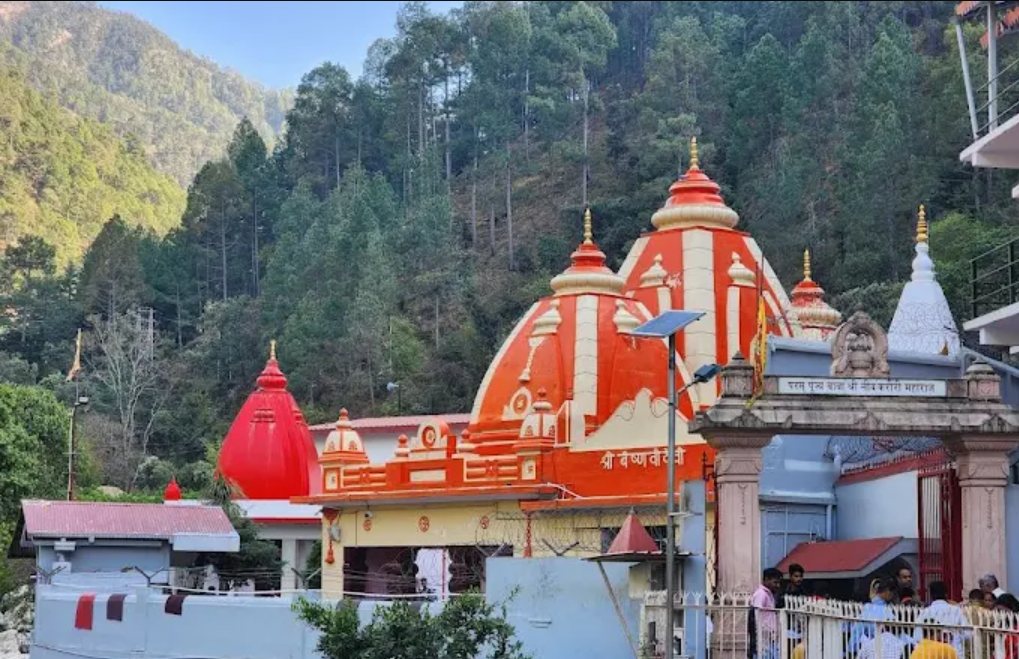
The gateway on the right is where the queue forms. By the time you reach it the camera should already be away. Photo via Google Maps contributor.
Two rules at Kainchi Dham are real and documented. Most of the rest of what you will read online was invented by somebody filling a page.
The short version: Kainchi Dham has two documented rules. A dress code, introduced by a temple board notice in August 2023, asks visitors not to enter in what the notice calls disrespectful and indecent attire. And photography and videography are prohibited inside the premises, a ban that was already in force before the dress code arrived and that the ashram restates every June, extended to reels. Everything else you will find online, the lists of banned garments, the phone-deposit counters, the locker rules, is either borrowed from other temples or made up. There is no entry fee, no ticket and no dress-code fine.
By Meghna Bora, Contributor, Nainital. About the author ↓
In the first week of August 2023 the temple board put up a notice outside Kainchi Dham. The decision behind it was taken at a meeting of the trust, and it was reported at the time by Amar Ujala, Zee News and Organiser among others. The wording is worth reading in full, because it is short and because almost nobody quotes it:
All devotees coming to visit the holy shrine of Sri Kainchi Dham are kindly requested to refrain from entering the temple premises wearing disrespectful and indecent attire, while maintaining the sacredness of the temple.
That is the rule. It names no garment, sets no measurement and prescribes no penalty. It is a request, backed by the practical position that the people on the gate can decline to let you in.
What this means for a visitor is simpler than the internet makes it sound. Cover your shoulders and your knees, avoid anything you would not wear into a relative's house on a formal occasion, and you will not be stopped. Kurta and pyjama, salwar kameez, a saree, trousers with a full-sleeve or half-sleeve shirt: all unremarkable. Men in shorts and women in short dresses or sleeveless tops are what the notice is aimed at, and Kainchi is a working ashram in a cold valley, so you are likely to want the extra layer anyway.
Kainchi was not doing anything unusual here. Naina Devi in Nainital had already put up a similar board, and through 2023 the same policy spread across temples run by the Mahanirvani Panchayati Akhara in Uttarakhand, and to Daksheshwar Mahadev in Haridwar and Neelkanth Mahadev near Rishikesh.
Search for the Kainchi Dham dress code and you will find page after page carrying the same tidy list: no torn jeans, no tight jeans, no night suits, no half pants, no western dresses, no lowers. It reads like a temple regulation. It is not one, at least not Kainchi's.
That list comes from a general 2023 news roundup of temple dress codes across India, printed alongside the Kainchi story rather than inside it. It describes what a number of temples nationally have prohibited. Somewhere along the way it got detached from its context, attached to Kainchi Dham specifically, and copied outward until it looked official.
We are pointing this out for a practical reason, not a pedantic one. If you plan a pilgrimage believing that jeans will get you turned away at the gate, you will pack differently and worry unnecessarily on a day that has enough logistics in it already. Clean, modest, ordinary clothing is the standard. The trust has not published anything more specific than that, and we are not going to fill the gap with a guess.
This is the rule people break most often, usually without meaning to, and it is the older of the two. When the dress-code notice went up in 2023, the reporting noted that the temple administration had already banned photography and videography at the temple some time before. So the camera restriction is not a recent tightening. It has been the position for years.
The ban covers photographs and video inside the temple premises. Staff enforce it, and they are not shy about it. Every June, when the foundation-day crowd arrives, the ashram administration restates the ban for the fair and spells out that this includes making reels, which tells you exactly which behaviour prompted the reminder.
Outside the complex you are free to shoot. The valley, the Shipra river below, the road curling in from Bhowali, the outside of the buildings from the roadside: none of that is restricted. Get your photographs on the approach, then put the phone away before you go in and leave it away.
Drones are a separate matter and a stricter one. Flying one in the area needs permission, and during the June foundation-day window the district administration has banned drone flying outright.
Here is where most guides to Kainchi Dham stop being useful, because they start describing procedures that no published source supports. We would rather mark the boundary honestly.
Phones. You can carry one in. What you cannot do is use it as a camera inside. We have found no documented rule requiring you to hand a phone over at the entrance, and no published description of a deposit counter or a token system for phones at Kainchi. If a page tells you your phone will be taken at the gate, ask yourself where that page got it.
Footwear. Shoes come off before the temple area, as they do at any Hindu temple in India. There are informal places to leave them near the entrance. There is no documented cloakroom, no numbered rack system and no fee that we can trace.
Bags. No published policy on bag size, bag deposit or lockers exists that we have been able to find. On an ordinary day this is a non-issue. On a busy weekend, carrying less simply makes a crowded courtyard easier, which is advice rather than a rule.
If any of this changes, or if you have been turned back over something not listed here, we would like to hear about it. The correction form is linked in the footer of every page on this site.
Nothing, is the short answer to the second half. There is no entry fee at Kainchi Dham, no ticket, and no paid queue that moves anyone ahead of anyone else. Donations are voluntary and are made in person at the donation box inside the complex. Anyone selling you a Kainchi Dham entry ticket or a priority darshan pass is selling something that does not exist, and we have written about that pattern at greater length elsewhere.
What people do bring is straightforward: flowers, a coconut, prasad, a red cloth, sometimes a blanket, which carries its own meaning in this lineage. Small stalls on the approach road sell all of it, so there is no need to carry offerings up from the plains.
Free prasad is served on several days of the week, at around 12:30 PM, and on Tuesday evenings after the kirtan. It is worth planning around rather than treating as a bonus. Our page on darshan timings goes through the day in detail, including why Tuesday is the long day and the busiest one.
The ashram at Kainchi is small. The road past it is narrow, the courtyard is not large, and on a Saturday in the season several thousand people move through a space that was never designed for them. Most of what makes a visit go smoothly is ordinary courtesy under pressure rather than anything written on a board.
15 June is the temple's foundation day, the anniversary of the consecration of the Hanuman murti in 1964, on a date Neem Karoli Baba fixed himself. It is a fixed date, not a movable one, and it brings lakhs of people into a valley with one road through it.
What changes in that window is mostly access rather than conduct, but it changes a lot:
These arrangements are made fresh each year by the Nainital district administration and the details shift. Treat the pattern as reliable and the specifics as something to confirm in the fortnight before you travel. If you want an ordinary, quiet darshan, pick any other week of the year.
Temple rules are the kind of thing that gets written once and then repeated for a decade without anyone going back to look, which is how the invented garment list spread in the first place. So this page carries a visible check date at the top and a scheduled next check.
What we re-read each time: the Nainital district administration pages, the temple trust's own site, and the news archive for any reported change to the notice or to the June arrangements. We separate what the trust has actually published from what circulates about it, and where we cannot source something we say so on the page rather than quietly rounding it into a fact.
Two things we would genuinely like from readers who have been recently: whether the gate is enforcing the dress code strictly or loosely at the moment, and whether anything is now being asked for at the entrance that this page does not mention.
Haldwani and Kathgodam sit 49 km out on the plains, on the railhead, where a room costs the same in June as in November and an early cab is simple to arrange.
The temple board put up a notice in August 2023 asking devotees to refrain from entering the premises in what it called disrespectful and indecent attire. That is the whole of the published rule. The notice does not list specific garments. Lists you may have seen elsewhere naming torn jeans, night suits, half pants and lowers come from a general roundup of temple dress codes across India, not from Kainchi Dham's own notice. In practice, ordinary modest clothing that covers the shoulders and the knees will not attract a second glance.
No. Photography and videography are prohibited inside the temple premises, and the ban predates the 2023 dress code notice. During the June foundation-day fair the ashram administration extends this explicitly to making reels. You can photograph the valley, the road and the river from outside; the restriction applies inside the complex. Staff do enforce it.
You can carry a phone in. What you cannot do is use it to shoot photos or video inside the premises. We have not found any documented rule requiring you to deposit a phone at the gate, and no published policy describes a locker or a phone-counter system. Anyone telling you there is a mandatory deposit is describing a rule we cannot trace to any source.
Footwear comes off before you enter the temple area, as at any Hindu temple, and there are informal places to leave it. Beyond that we have not found a documented policy on bags, cloakrooms or lockers, so we are not going to invent one. Travel light on a busy day for practical reasons rather than regulatory ones.
Yes, substantially, though most of what changes is access rather than conduct. 15 June is the temple's foundation day. In recent years the district administration has run a zero-traffic zone on 14 and 15 June, stopped private vehicles at Bhowali and moved everyone onto shuttles, and banned roadside bhandaras and food carts on the approach roads. The ashram's photography ban is restated for the fair and extended to reels. If you want an ordinary darshan, this is the fortnight to avoid.
No to both. Entry is free, there is no ticket and there is no VIP darshan queue. There is also no published penalty attached to the dress code; the notice is a request backed by the practical fact that staff can decline entry. Donations are voluntary and go in the donation box in person.