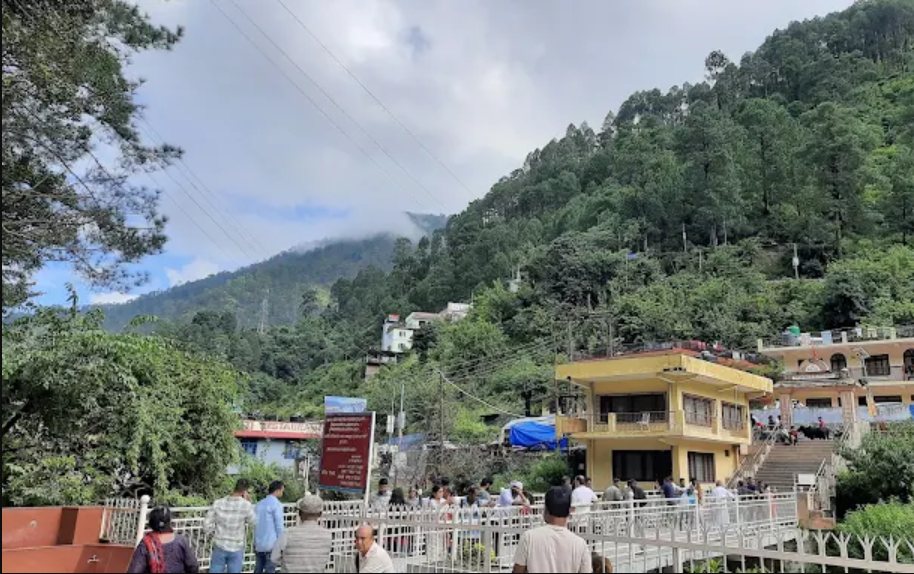
Nainital district counts every visitor to the temple on camera. The numbers say the months everyone recommends are the busiest ones, and the quietest month of the year is the one nobody names.
The short version: Nainital district counted 4,753,629 visitors at Kainchi Dham over the eleven months from August 2025 to June 2026, using CCTV and number-plate cameras installed for a carrying-capacity survey. The busiest month was June 2026, with 866,000. The quietest was September 2025, with 174,135, just under a fifth of June. That matters because almost every travel page recommends March to June, which the data shows is the single busiest stretch of the year. If you want a calm darshan, the quiet window is August, September and February. Of those three, February is the one we would actually book: it is quiet and dry, while August and September are quiet because it is monsoon and the hill roads are unreliable.
For eleven months the Tourism and Planning Department has been running a carrying-capacity survey at Kainchi Dham. CCTV and ANPR number-plate cameras in and around the temple premises count arrivals, and the District Economics and Statistics Office sends the monthly total to the state government. Amar Ujala published the full series on 31 July 2026, attributed on the record to Dr Mukesh Singh Negi, the District Economics and Statistics Officer for Nainital.
As far as we can tell this is the only complete monthly footfall series for Kainchi Dham anywhere in print, and it has not appeared in English before. Here it is.
| Month | Visitors | Average per day | Against the busiest month |
|---|---|---|---|
| August 2025 | 219,627 | 7,085 | 25% |
| September 2025 | 174,135 | 5,805 | 20%, the quietest month |
| October 2025 | 353,707 | 11,410 | 41% |
| November 2025 | 362,721 | 12,091 | 42% |
| December 2025 | 428,842 | 13,834 | 50% |
| January 2026 | 441,349 | 14,237 | 51% |
| February 2026 | 257,856 | 9,209 | 30% |
| March 2026 | 458,215 | 14,781 | 53% |
| April 2026 | 506,868 | 16,896 | 59% |
| May 2026 | 684,309 | 22,075 | 79% |
| June 2026 | 866,000 | 28,867 | 100%, the busiest month |
| Eleven months | 4,753,629 | 14,232 | 334 days |
One note on the total before anything else. Amar Ujala reports the eleven-month figure as 47,53,000, a rounded number. The eleven monthly values add up to 4,753,629. We have used the sum of the parts, because that is what the months in the table actually come to, and we have said so here rather than quietly picking one.
September 2025 brought 174,135 visitors, an average of 5,805 a day. June 2026 brought 866,000, an average of 28,867 a day. June is very close to five times September.
Five times is not a marginal difference you might notice in the queue. It is the difference between walking up to the murti and standing in a line that reaches back along the road. It changes where you can park, how long the drive up from Bhowali takes, whether the prasad has run out by the time you reach the counter, and whether you can hear anything at all inside the complex.
The three quietest months in the series are all outside the season people are told to travel in: September, August and February. Between them they average 9,366 visitors a day. The three busiest, June, May and April, average 22,613. You are choosing between two genuinely different temples.
Search for the best time to visit Kainchi Dham and you will be told, over and over, to come between March and June. Sometimes the window is given as April to June, sometimes March to July, but the shape is always the same.
Against the count, that window contains the four busiest months of the year. March, April, May and June are 53%, 59%, 79% and 100% of peak respectively. Recommending them as the best time to visit a temple in a one-road valley is recommending the queue.
To be fair to the advice, it is not invented. March to June is genuinely the most pleasant weather in Kumaon, the roads are dry and open, and it is when the plains are hot enough that people want to be in the hills. The advice is answering the question "when is the weather nicest," which is a reasonable question. It is just not the same question as "when should I go to this particular temple," and for Kainchi Dham the two answers pull in opposite directions.
The June figure has a second driver on top of the weather. The temple's foundation day falls on 15 June and draws a crowd large enough that the district runs a separate traffic and shuttle operation around it, with vehicle restrictions and parking assigned by which direction you arrive from. A month containing that event was always going to top the table.
Here is where the data stops being trivia and starts being useful.
The two quietest months, September and August, are quiet for a reason that should give you pause: they are the monsoon. The hill roads in Kumaon are genuinely unreliable in July, August and September. NH 109 has a bad record at Quarab, and slips and closures on the Haldwani to Nainital stretch are routine. Quiet is not worth much if you spend the day sitting behind a landslide. We would not send anyone up in that window unless they were relaxed about losing a day.
February is the exception, and it is the interesting number in the whole table. At 257,856 visitors and 9,209 a day, February sits at 30% of peak, closer to monsoon September than to its own neighbours. January runs at 14,237 a day and March at 14,781. February drops about 35% below both, and it is not the short month doing it, because these are daily averages that already correct for that.
So February gives you a genuinely quiet temple in a month with dry roads, clear air, and the long views that the hills are actually worth coming for. It is cold, and the ashram opens later in winter than in summer, which is worth planning around. But if you want the quiet without the monsoon risk, February is the answer the data gives, and we have not seen a single page recommend it.
We should say plainly that we cannot explain the February dip. School terms, the cold, the gap between the New Year rush and the spring season, or simply one unusual month in a single year of data, all are plausible and we have no evidence for any of them. One February is not a pattern. Treat it as a strong hint rather than a law, and we will revisit it when the next February is counted.

The survey is a carrying-capacity exercise, not a tourism promotion. The district is trying to establish how many people the site can physically take, which is a question that has been getting sharper as the numbers climb. The counting is done by CCTV inside the temple area and ANPR cameras reading vehicle number plates on the approach.
That method has consequences worth knowing before you lean on the numbers.
It counts arrivals rather than distinct people, so anyone visiting twice in a month is counted twice. It is a machine count, so it does not distinguish a devotee from a driver waiting outside. And a system built partly on number-plate reads will treat a full Innova differently from five motorcycles, which matters in a month like June when two-wheelers are restricted on the approach anyway.
None of that undermines the shape of the series. Whatever the cameras are counting, they counted it the same way in September as in June, and the ratio between the two is the part you are actually using. It does mean the absolute totals should be read as a good official estimate rather than a headcount.
The Amar Ujala report also notes where the visitors come from, which is its own small piece of useful information: Delhi, Noida, Lucknow, Kanpur, Meerut, Rampur, Moradabad, Dehradun, Rudrapur and Haldwani are all named, along with Maharashtra, Rajasthan, Haryana, Mumbai and Gujarat, and visitors from outside India. Most of that list arrives by train at Kathgodam, which is the practical reason so many Kainchi Dham trips start with a night on the plains.
There is a second official figure in circulation and it does not agree with this one.
In June 2025, at a meeting chaired by the Chief Minister on crowd management at Kainchi Dham, the District Magistrate is reported to have said that around 24 lakh devotees had visited in the past year, against an average of about 8 lakh previously. That is 2.4 million where the camera series says 4.75 million.
We are not going to pretend to reconcile them, because we cannot. They cover different periods, the DM's statement predates most of the camera series, and they are almost certainly different counting methods: an administrative estimate on one side and an automated arrival count on the other. It is also possible that "24 lakh against a usual 8 lakh" was making a point about growth rather than offering a precise annual total.
What both numbers agree on is direction. Whatever the true figure, visits to Kainchi Dham have risen steeply, they rose enough for the state to commission a carrying-capacity study and consider a Chardham-style advance registration system, and the month-to-month shape of the camera series is not in dispute. Use the ratios. Be careful with the absolutes.
Four honest recommendations, depending on what you are actually optimising for.
If you want the quietest possible darshan and the roads do not worry you: September. It is the lowest month in the series by a clear margin, the valley is green, and the light after the rain is the best of the year. Accept that a landslide day is a real possibility and keep the itinerary loose. Our monsoon guide to Haldwani is honest about what that season is like.
If you want quiet without the risk: February. Thirty per cent of peak, dry roads, clear views. Bring a proper jacket, and check the winter darshan timings, because the ashram opens later in the cold months and a dawn start from the plains needs different arithmetic.
If you are combining the temple with a hill holiday: October or November, at 41% and 42%. Not quiet, but well below the spring peak, with the most reliable weather of the year. This is the sensible compromise if Kainchi is one stop in a larger trip through Nainital and Bhimtal.
If the bhandara is the point: June, deliberately, and plan it as an event rather than a visit. Foundation day on 15 June is a different proposition entirely, with its own traffic order, parking allocation and shuttle service. Go because you want to be there for it, not because a listicle told you June was pleasant.
Whichever month you pick, the arrival hour matters more than most people expect, and it matters most in the busy months. The window worth aiming for on any ordinary day is opening time to about 8:30 AM, which from the plains means leaving well before dawn.
This is monthly data, and the things that will actually shape your morning are mostly smaller than a month.
It cannot tell you about days of the week. Tuesday is Hanuman's day and Kainchi Dham is a Hanuman temple, so Tuesday runs busier and later than the rest of the week, and weekends are heavier than weekdays. A quiet month still has busy Tuesdays. A busy month still has quiet Thursday mornings.
It cannot tell you about the hour, which at Kainchi is the single biggest lever you control.
It cannot tell you what next year will do. This is eleven months from one survey, in a period when the numbers were climbing. If growth continues, every month in the table is a floor rather than a forecast.
And it cannot tell you about the road on your particular day, which in the monsoon months is the thing most likely to decide whether the trip happens at all.
One last caveat about this page itself. Everything above rests on a single news report of a government dataset. We have read that report directly rather than taking it second hand, and the monthly figures we publish are the figures it prints. But the underlying survey is not published in full anywhere we can find, so there is no second source to check it against. If the department publishes the series itself, or a later month changes the picture, we will update this page and say what changed.
From Haldwani and Kathgodam the drive is 49 km through Bhowali, which makes an early darshan a decision about where you sleep the night before. Rooms on the plains cost the same in February as in June.
September. Nainital district's camera count recorded 174,135 visitors in September 2025, an average of 5,805 a day, which is the lowest month in the eleven-month series and just under a fifth of June's 866,000. August is second lowest at 219,627 and February third at 257,856. The catch with August and September is that they are monsoon months, when hill roads in Kumaon are unreliable. February is the quiet month with dry roads.
June, by a wide margin. June 2026 recorded 866,000 visitors, an average of 28,867 a day, which is close to five times the September figure. Two things drive it: the weather in the hills is at its most attractive as the plains heat up, and the temple's foundation day on 15 June draws crowds large enough that the district runs a separate traffic, parking and shuttle operation for it. May is second at 684,309.
It is the most commonly given advice and it is the busiest stretch of the year. Against the district's own count, March, April, May and June run at 53%, 59%, 79% and 100% of the peak month. The advice is answering the question of when the weather is nicest, which it genuinely is, rather than when the temple is manageable. For a calm darshan the data points to February, or to August and September if you can absorb monsoon road risk.
Nainital district counted 4,753,629 arrivals over the eleven months from August 2025 to June 2026, using CCTV and ANPR cameras installed for a carrying-capacity survey. Amar Ujala reported the total as a rounded 47,53,000 on 31 July 2026, attributed to the District Economics and Statistics Officer. A separate official statement from the District Magistrate in June 2025 put the figure at around 24 lakh for the previous year against a usual 8 lakh, which does not reconcile with the camera series. The two almost certainly use different periods and methods.
From a carrying-capacity survey run by the Tourism and Planning Department, which has been counting arrivals at Kainchi Dham for eleven months using CCTV in the temple area and ANPR number-plate cameras on the approach. The District Economics and Statistics Office compiles the monthly totals and sends them to the state government. The monthly series was published by Amar Ujala on 31 July 2026 and attributed on the record to Dr Mukesh Singh Negi, the District Economics and Statistics Officer for Nainital.
Not on its own. The monthly count tells you the season, not your morning. Tuesday is Hanuman's day and runs heavier and later than the rest of the week, weekends are busier than weekdays, and the hour you arrive is the biggest single factor you control. Opening time to about 8:30 AM is the window worth aiming for in any month. A quiet month with a late Saturday arrival can easily be busier than a peak month at seven in the morning.
It depends on how much slack your trip has. August and September are the two quietest months at the temple, and the valley is at its greenest, so the experience itself is excellent. The risk is the road rather than the temple: NH 109 through Kumaon has a poor monsoon record, particularly at Quarab, and closures of several hours are common. If you can absorb losing a day, the monsoon gives you the calmest darshan of the year. If your schedule is tight, take February instead.