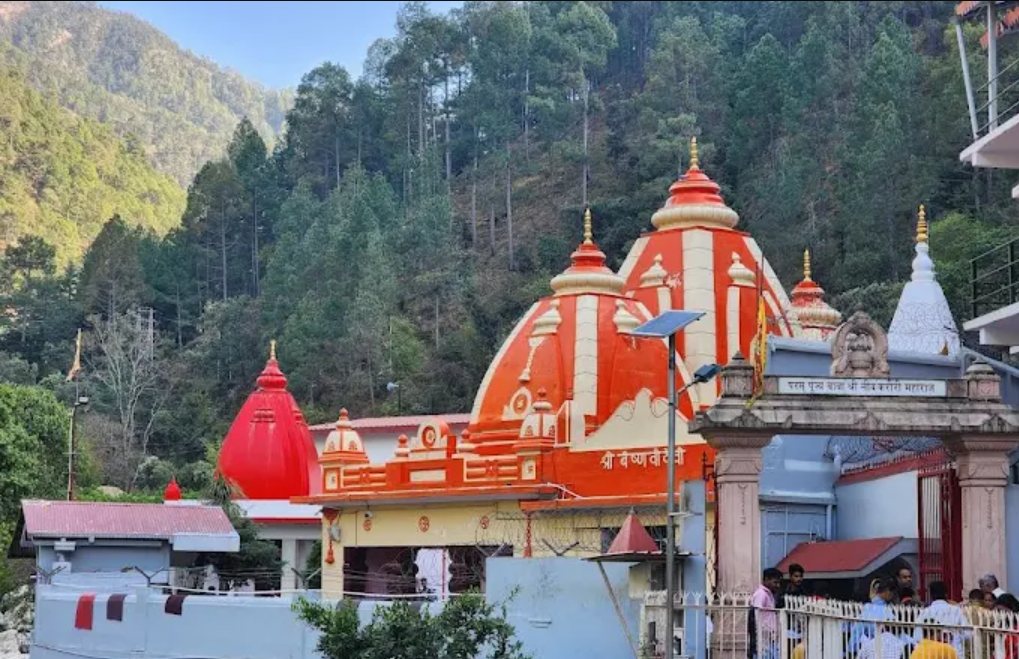
Kainchi Dham on the road between Bhowali and Almora. The hillside pressing in directly behind the temple is why no hotels have ever been built here. Photo via Google Maps contributor.
Dozens of websites will sell you a room at the ashram. The ashram does not have rooms to sell. Here is what is true, and where people actually sleep.
The short answer: no. You cannot book a room at the Kainchi Dham ashram, and there is no dharamshala there that the public can reserve. The Neem Karoli Baba Ashram in Taos, the main organisation in the English-speaking world connected to this lineage, states plainly that Kainchi Dham is not currently inviting visitors for overnight stays and has no public telephone number or email address. It also warns readers directly about false information circulating about the temple. Several websites with addresses that closely resemble the real temple trust do quote room types and nightly rates. Those websites are not the temple. What visitors actually do is stay in Bhowali at about nine kilometres, Bhimtal at about sixteen, Nainital at about seventeen, or down on the plains in Haldwani and Kathgodam, and drive in early the next morning.
By Nandini Upreti, Contributor, Almora. About the author ↓
You cannot book a room at the Kainchi Dham ashram. There is no guest house you can reserve, no rooms you can pay for, and no booking desk that takes requests from the general public. The temple does not run accommodation as a service, and it does not publish a phone number or an email address for people who want to arrange a stay.
This matters because a lot of websites say otherwise. If you search for a room at the ashram, you will find pages that show room types, quote nightly rates, list phone numbers and tell you to write to the temple office two weeks in advance. None of those pages belong to the temple.
So the real question is not whether you can sleep at the ashram. The real question is which town you should sleep in so that you can reach the temple early the next morning. That answer is in the second half of this article.
The clearest statement on this comes from the Neem Karoli Baba Ashram in Taos, New Mexico. That ashram was set up by devotees of the same teacher, and it is the main organisation in the English-speaking world connected to this lineage. It keeps a page about Kainchi Dham for people who plan to travel to India.
On that page it states plainly that Kainchi Dham is not currently inviting visitors for overnight stays, and that the temple does not have a telephone number or an email address for the public. It also warns readers directly about schemes, scams and other false information circulating about the temple.
The same page tells visitors that most people stay in Nainital or Bhowali, or somewhere else outside the ashram, and visit the temples during the day. That is the honest picture, and it comes from an organisation with no hotel to sell you.
The temple trust in India also runs its own website. It was launched in June 2024, and one of the stated reasons for launching it was that people were being misled online. Anything presented as official that does not come from the trust's own site should be treated with care.
There is a cluster of websites built around the temple's name. Several of them carry web addresses that look almost identical to the real trust website, with one or two words changed or removed. They rank well in search results, they look reasonably professional, and several of them describe an ashram booking process in confident detail.
What they typically offer is a list of room categories, a nightly price, a contact number, and instructions to book in advance. Some of them tell you to apply a month ahead if you are travelling in June. The detail is what makes them convincing. Real booking systems do not usually need to explain themselves that thoroughly.
We are not going to accuse any particular website of fraud, because we cannot see what happens after someone makes a call. What we can tell you is what is verifiable. The temple trust has one website. The ashram does not publish public contact details for stays. Any page beyond that is a third party, whatever its web address suggests.
The practical risk is straightforward. You may pay a deposit for a room that does not exist. You may also arrive at the temple at ten at night believing you have somewhere to sleep, which in the hills, in the cold, with no hotel within nine kilometres, is a genuinely difficult position to be in.
You do not need any technical knowledge to do this. Four simple checks will tell you almost everything.
Check whether the page is selling a room at the ashram itself. This is the single strongest signal. The ashram does not sell rooms. A page that offers to book you one is not the ashram, no matter how the web address is spelled.
Read the web address slowly, word by word. The look-alike addresses work because your eye skips over a missing word or a changed ending. Read it the way you would read a bank account number, one piece at a time.
Be careful with any page selling entry tickets or special darshan passes. There is no entry fee at the temple, there is no ticket, and there is no paid queue that lets you go in ahead of other people. Everyone waits in the same line. Anyone charging you for entry is selling something that does not exist.
Treat a price list as a warning sign, not a reassurance. On most travel websites a clear price list is a good sign. Here it is the opposite, because the thing being priced is not for sale.
If you want to make a donation, do it in person at the temple donation box when you visit. Donations are voluntary and nobody at the temple will ask you for money at the gate.
Once you accept that the ashram is a place you visit rather than a place you stay, planning becomes much simpler. You are choosing a town, and there are four sensible ones.
There is almost nothing at Kainchi Dham itself. The temple sits in a narrow river valley with a hill rising on the other side. There is no room for a hotel strip, and no hotel strip has grown there. A small number of guest houses and one mid-range resort operate nearby, and the Taos ashram page names a couple of them for people who ask, but the supply is tiny and it fills quickly in season.
Everyone else stays in one of four places. Bhowali is the closest town at about nine kilometres. Bhimtal is about sixteen kilometres away. Nainital is about seventeen kilometres away. Haldwani and its neighbouring railway town of Kathgodam sit further out, at roughly forty three to forty nine kilometres, down on the plains where the hills end.
The right choice depends on what kind of trip you are taking, and the differences are bigger than the distances suggest.
Bhowali, about nine kilometres away. This is the closest town with a real supply of beds, and if your only goal is to be at the temple gate early in the morning, it is the sensible answer. It is a small hill town with modest guest houses rather than large hotels, and the prices reflect that. You will not find much in the way of restaurants or evening activity, and the choice of rooms is limited enough that you should book ahead in season.
Bhimtal, about sixteen kilometres away. A lake town with a wider range of places to stay, from simple guest houses to comfortable resorts. It works well if you want the temple visit to be part of a small holiday rather than the whole purpose of the trip. One thing to know is that Bhimtal has become an official parking point for the temple on weekends, which is convenient if you are driving and are willing to leave your car and take the shuttle.
Nainital, about seventeen kilometres away. The largest choice of hotels by a wide margin, and the most to do in the evening. It is also the most crowded, the most expensive in season, and the slowest to get out of on a busy morning. If you are travelling with family who want a proper hill station holiday around the temple visit, Nainital makes sense. If you want to be at the temple by six in the morning, the traffic will work against you.
Haldwani and Kathgodam, about forty three to forty nine kilometres away. These are on the plains rather than in the hills, and they are where the railway line ends. This is the practical base for anyone arriving by train, anyone travelling on a tight budget, and anyone who wants a room that costs the same in June as it does in November. Rooms are cheaper and more plentiful than anywhere in the hills, and the road up is a straightforward drive on National Highway 87 through Bhowali.
We should be straightforward about our own position here. This website is based in Haldwani. Haldwani is not the closest option and we are not going to pretend it is. Bhowali is closer, and if the only thing that matters to you is proximity, stay in Bhowali. What Haldwani offers is a different set of advantages, and they are worth understanding before you decide.
The temple is calmest in the first few hours of the day. By the middle of the morning the queue lengthens, and on weekends and holidays it lengthens considerably. Almost everything about planning a visit comes back to how early you can get there.
From Bhowali you need about twenty to thirty minutes, which means you can have a normal breakfast and still arrive early. From Bhimtal allow about forty minutes. From Nainital allow forty to fifty minutes on a quiet morning and longer on a busy one, because you have to get out of the town first. From Haldwani or Kathgodam the drive is about one hour and forty minutes in ordinary traffic, so an early start means leaving around half past five in the morning.
That last number sounds like a disadvantage, and on a quiet weekday it is. But there are two situations where it stops being one.
The first is if you are arriving by train. The overnight train from Delhi reaches Kathgodam in the early hours of the morning, which puts you at the bottom of the hill at exactly the right time. You are not losing a morning, you are using one you would otherwise have spent travelling.
The second is during the busiest days of the year. When the roads above Bhowali are closed to private vehicles, which happens on the temple's foundation day in June and on some weekends, being in the hills stops being an advantage. The buses that carry visitors up start from the plains, including from Haldwani and Kathgodam. On those days a room near the starting point is worth more than a room near the temple.
There is also a public bus. A state bus service has run directly from Haldwani and Kathgodam to the temple since June 2024, at a fare of around one hundred and ten rupees, with several services a day. For a visitor travelling alone or as a couple, that is a considerably cheaper way to reach the temple than hiring a car, and it is the only base that has one.
If you want the full comparison, including what each town costs and which one suits which kind of trip, we have written that up separately in our guide to choosing a base for a Kainchi Dham visit.
Decide first whether the temple is the whole trip or part of a longer holiday, because that single decision settles most of the rest. A short focused visit points you towards Bhowali or the plains. A longer holiday points you towards Bhimtal or Nainital.
Book a room in a named town with a real address, and avoid anything advertised as being at the ashram. Check the day of the week you are travelling, because weekend rules on vehicles are different from weekday rules. Avoid the middle of June unless the crowd is the reason you are going, since the temple's foundation day on the fifteenth of June draws enormous numbers.
And if a page asks you to pay in advance for a room at the ashram, close it. There is nothing there to buy.
Haldwani and Kathgodam are where the train arrives, where rooms cost the same in June as in November, and where the public bus to the temple starts.
No. There is no public accommodation at the Kainchi Dham ashram that you can reserve or pay for. The Neem Karoli Baba Ashram in Taos, which is the main organisation in the English-speaking world connected to this lineage, states that Kainchi Dham is not currently inviting visitors for overnight stays and does not have a telephone number or an email address for the public. Websites that quote room types and nightly rates for the ashram are run by third parties, not by the temple. Visitors stay in Bhowali at about nine kilometres, Bhimtal at about sixteen, Nainital at about seventeen, or down on the plains in Haldwani and Kathgodam.
There is no dharamshala at the temple that the general public can book. A dharamshala has been included in government plans for improving the area, but as far as we can establish it has not been built, and nothing of that kind is open to visitors today. If you need somewhere inexpensive to sleep, the practical answer is a guest house in Bhowali or a budget hotel in Haldwani or Kathgodam, where rooms are widely available and cost far less than the hill towns in season.
The temple trust runs one website, launched in June 2024, and one of its stated reasons for launching was that people were being misled online. Several other websites use web addresses that closely resemble it, with a word changed or removed. The simplest test does not involve checking addresses at all. If a page is offering to book you a room at the ashram, or selling you an entry ticket or a special darshan pass, it is not the temple, because none of those things exist. Read any web address slowly, one word at a time, before you trust it.
No. Entry is free, there is no ticket, and there is no paid queue that lets anyone go in ahead of others. Everyone waits in the same line. Donations are voluntary and are made in person at the donation box inside the temple. Anyone selling entry tickets or priority passes is selling something that does not exist. The state government has announced that it is considering an online registration system with a daily limit on visitors, but that system is not running as of August 2026 and no booking is required to visit.
Most people stay in Nainital or Bhowali, or in another town nearby, and visit the temple during the day. Bhowali at about nine kilometres is the closest town with a real supply of rooms and is the best choice if an early morning visit is your only priority. Bhimtal at about sixteen kilometres suits a longer holiday. Nainital at about seventeen kilometres has the widest choice of hotels but the heaviest traffic. Haldwani and Kathgodam, roughly forty three to forty nine kilometres away on the plains, are the cheapest and are where the railway line ends.
As early as you reasonably can. The temple is calmest in the first few hours of the day, and the queue builds through the morning, particularly on weekends and holidays. From Bhowali the drive takes about twenty to thirty minutes. From Bhimtal allow about forty minutes, and from Nainital allow forty to fifty minutes on a quiet morning. From Haldwani or Kathgodam the drive is around one hour and forty minutes in normal traffic, so a very early start means leaving at about half past five in the morning.