
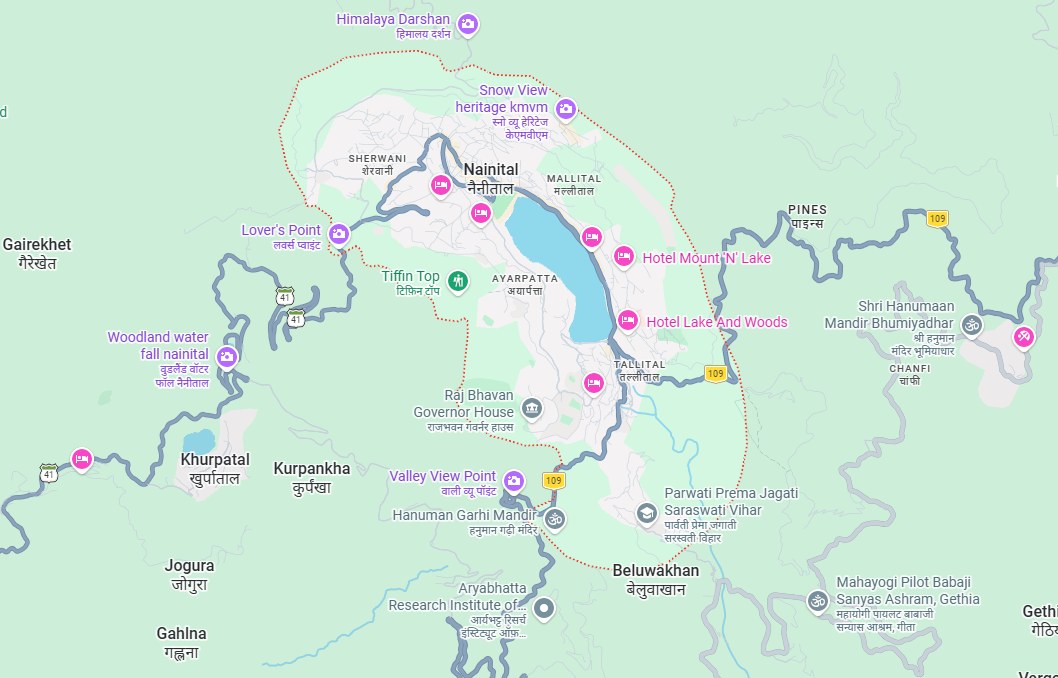
Nainital town: Mallital at the north end of the lake, Tallital at the south near the bus stand, and Mall Road running between them. Map via Google Maps.
Most of the worry about this happens before you arrive. Here is what the desk really asks for, why a refusal happens when it does, and what to do in the ten minutes after one.
The short answer: checking in is usually a two-minute formality. No law in India stops two adults sharing a hotel room, and the desk is not asking about your relationship. It wants a government photo ID for each of you, which it copies into the guest register along with your dates. Marital status is not a field in that register. Refusals do still happen, and when they do it is a house rule, not the law, which is why arguing rarely works and moving on usually does. Nearly all the trouble comes from five specific situations, and four of them can be settled with a phone call the day before. If you are still choosing where to book, start with couple-friendly hotels in Nainital.
By Meghna Bora, Contributor, Nainital. About the author ↓
Here is the thing most people are surprised by: the front desk is not interested in your relationship. It is interested in its paperwork. A licensed hotel has to keep a guest register, and that register has fields it must fill for every adult sleeping in the room.
So the ask is short. A government photo ID for each of you. Aadhaar is the easiest because the photograph, the number and an address all sit on one card, which fills the register in one go. A passport, voter ID or driving licence does the same job. A PAN card on its own does not, because it carries no address, so keep that as a backup rather than your main document.
Some desks will photocopy the IDs, some will photograph them on a phone, and some will just type the numbers in and hand the cards straight back. Any of those is normal. Many properties also take an advance or a card at this point, particularly in season.
What is not on the form, anywhere, is whether you are married. There is no box for it. When a desk brings it up, that is a person talking, not a document.
Written out it sounds longer than it feels. In practice this takes about five minutes.
1. Both of you hand over ID. Not one of you. Both adults in the room get registered, so both cards come out.
2. The desk fills the register. Name, address, ID type and number, arrival date, expected departure, usually a phone number.
3. They copy or photograph the IDs, then hand them back. Ask for them back if the desk seems to be keeping them, since there is no reason for a property to hold your documents once it has the details.
4. You pay the advance, if the property takes one, and you get a receipt.
5. You get the key, and at smaller places someone walks you up.
That is the whole thing. Nobody asks a follow-up question in the great majority of check-ins, and the ones who do are usually just making conversation.
Refusals are not common, but they are common enough that people worry about them. It helps to be clear about what is actually going on.
There is no law being enforced. Nothing in Indian law prevents two consenting adults from sharing a hotel room, married or not. When a property turns you away, it is applying its own house rule. It is allowed to have house rules. It is just not enforcing a statute, whatever it says at the counter.
The real reasons sit behind the counter. An owner with a personal view on it. A property that mostly hosts families and pilgrim groups and would rather not mix the two. A worry about a complaint from someone in the neighbourhood. Or, most often, a staff member on a night shift who does not know the house rule and picks the safer answer for himself, which is no.
The reasons you can ignore. If you are told it is the law, or that the police do not allow it, or that Uttarakhand's Uniform Civil Code requires proof of marriage, none of that is accurate. The UCC introduced a registration requirement for live-in relationships, meaning people setting up a shared household. A weekend in a hotel room is not that, no property in Nainital asks for a UCC certificate, and none can. We work through that rule in detail in OYO in Nainital for unmarried couples.
Knowing all this does not mean you should argue it at the desk. You are not there to win a point about the law. You are there to get a room, and the fastest route to a room is the next property that says yes.
Almost every difficult check-in we hear about is one of these five. Four can be settled before you arrive.
1. You turn up late at night without a booking. This is the hard one. The night shift is less sure of the house rule, the properties that would have said yes may already be full, and you have no leverage because you have nowhere else lined up. A call ahead, even half an hour before, changes the whole shape of the evening: you get your yes or your no while you still have choices.
2. You are asked for a marriage certificate. Nobody is entitled to require one, and the register does not have a place to record it. A calm, factual line works best: you have valid government photo ID for both of you, which is what the register needs. If they still insist, that is a house rule, and the answer is to leave rather than to argue.
3. Your surnames do not match. This is the worry that sends people looking for workarounds they do not need. Two different surnames on two IDs is completely ordinary, plenty of married couples have them too, and any desk running a couple-friendly policy sees it every week. Do not over-explain. Hand over the IDs and let the paperwork happen.
4. Only one of you has an ID. This one is a genuine problem, and it is not about your relationship. The property cannot register a guest it has no document for. The fix is easy if you catch it early: the eAadhaar PDF on a phone is accepted almost everywhere. Check this before you leave, not at the counter.
5. You are asked to leave after checking in. Rare, and it usually follows a shift change. Ask for the manager, ask to see the property's policy, and ask for a refund of the nights you will not be using. Photograph the booking confirmation and the payment receipt before you move, and if you booked through an app, raise it in the app while you are still at the desk.
Privacy is the part people ask about most quietly, so it is worth being plain about it.
What is recorded: your name, an address, the type and number of the ID you showed, the date you arrived and the date you expect to leave, and usually a phone number. That is the shape of a hotel register anywhere in the country.
What is not recorded: your marital status, your relationship, or any note about who you arrived with beyond the fact that two named adults are in one room. There is no field for it because no rule asks for one.
Who can see it: the property keeps the register because state rules require it, and local police can inspect hotel registers as a routine check. That is a records check on the property, not an interest in you. Foreign nationals are the one extra step, because the property files a Form C for them.
What does not happen: the hotel does not contact your family, your employer or anyone else. Give your own phone number rather than someone else's, take your ID cards back once they have been copied, and that is genuinely the end of it.
Assume it will not happen, but know the moves, because the difference between an awkward twenty minutes and a ruined evening is mostly speed.
Do not argue the law. You are right, and it will not get you a room. It tends to harden the desk instead.
Ask one question: is this the property's policy, or is it tonight's shift? Asked politely, this sometimes gets a manager involved, and a manager sometimes overrides it. If the answer is that it is the policy, you have learned what you needed and you can go.
If you booked through an app, log it before you leave the lobby. Open the booking, report the issue, and take screenshots of the confirmation and the property's listing. Doing it at the desk rather than afterwards matters, because the timestamp does some of the arguing for you. The full refund and re-book routine is in the OYO Nainital guide.
Move, and move towards density. Mall Road and the Mallital end have licensed hotels close together, and the Tallital end near the bus stand has more budget and independent stock. Walking into two or three desks in a row beats standing at one.
Keep the money clean. Do not pay anything before you are actually checked in and holding a key.
If it is peak season and the town is full, the honest fallback is to come down the hill. Haldwani is 38 km below with far deeper couple-friendly stock, and the plains strategy guide covers when that is the better call. Arriving by train, couple-friendly hotels near Kathgodam station lists six licensed options at the railhead.
Phone the property the day before. Two minutes, and it removes almost all of the risk. Ask whether they accept unmarried couples with Aadhaar for both partners, whether the policy is the same on the night shift, and whether the desk can note your arrival name so the night staff has it. Our ID rules guide has the longer version of that call.
Prefer a licensed hotel that keeps its own register. It is the deepest pool of rooms in Nainital by a wide margin, it takes a local Uttarakhand Aadhaar without fuss, and it is not bound by any app's internal politics.
Arrive before 8 PM if you can. Day-shift check-ins are simply easier, and you keep your options open if something goes wrong.
Carry ID for both of you, and check it before you leave home. The eAadhaar PDF on a phone counts.
For which properties and which part of town to aim at, couple-friendly hotels in Nainital goes area by area, and the Nainital couple price list covers what a room costs across the seasons.
One phone call the day before removes nearly every version of this problem. Start with the couple-friendly pillar, then pick your area.
A hotel can ask, but nothing obliges you to produce one, and no rule requires a property to see one. The guest register needs a government photo ID for each adult, and marital status is not one of its fields. If a desk asks, the useful reply is that you have valid photo ID for both of you, which is what the register requires. If they still insist, treat it as a house rule rather than an argument to win, and go somewhere else. In a town where several hundred properties take walk-ins, moving on is faster than debating.
This is the one situation where a refusal is not about your relationship at all. Both adults staying in the room have to be entered in the register, and each entry needs an ID. With only one ID between you, a licensed property cannot complete its paperwork and will usually say no. The easy fix is digital: the eAadhaar PDF on a phone is accepted almost everywhere, as is a photo of a passport, voter ID or driving licence in most places. Sort this out before you drive up rather than at the desk.
No. Hotels keep a guest register because state rules require one, and local police can inspect those registers as a routine check. What the register holds is ordinary: names, an address, the ID type and number, and your arrival and departure dates. There is no marital status field, no relationship field, and no report generated about who is sharing a room. Foreign nationals are the one addition, since the property files a Form C for them. Nobody calls your family, and nothing about your relationship is recorded.
It is rare, and it usually happens at a shift change, when a night manager applies a stricter reading than the person who checked you in. If it happens, ask calmly for the manager and for the property's written policy, and ask for a refund of any unused nights before you move. Photograph your booking confirmation, the payment receipt and the room key or door number first. If you booked through an app, open a ticket while you are still standing at the desk, because the timestamp and location strengthen the claim.
This is the hardest version of the situation, and it is worth avoiding. Late arrivals meet the night shift, who are more likely to default to no when they are unsure of the house rule, and by then the properties that would have said yes may be full. Even a call thirty minutes ahead changes the odds, because you get a yes or a no while you still have options. If you are already in town and stuck, the Tallital end near the bus stand carries more budget and independent stock than the Mall Road stretch, and walking in there tends to work better than circling Mallital.
Both guests need to be adults, which means 18 or over, and the ID you present is what proves it. This is the one age rule that genuinely applies, and a property that checks it is doing the right thing rather than moral policing. Some properties set their own higher bar as a house rule, though that is uncommon. Carry ID that shows your date of birth clearly, and expect it to be looked at rather than waved through if you look young.