

State Disaster Response Force staff on a snow-craft course on the Auli slopes in February 2017. Photo © Nanda Devi Institute of Adventure Sports, CC BY-SA 4.0, via Wikimedia Commons.
When snow reaches Auli’s slopes, how it has varied over the last three winters, how cold the days and nights get from November to March, and what is open this season now that the ropeway from Jyotirmath has been shut for nearly four years.
The short answer: Snowfall in Auli usually begins on the slopes between early December and late January and keeps coming until March, but the first fall moves a great deal from one winter to the next: it came on 17 January 2024, on 8 December 2024 and not until 23 January 2026. So January and February are the safe months for snow, and December is a gamble that paid off in one of the last three winters. It is properly cold. Averaged over those three winters, January days on the slopes reach about 7°C and nights fall to about minus 8°C. The ropeway from Jyotirmath, the town most people still call Joshimath, has been shut since January 2023 and no restart has been announced, so you reach Auli by the 12 km road from Jyotirmath, which ices over after snow. The GMVN chairlift on the slopes is a separate lift, and it ran last winter. From Haldwani it is 308 km by road, about ten and a half hours without stops, which in winter means two days.
By Meghna Bora, Contributor, Nainital. About the author ↓
Most of this page holds good every winter. The things below change from season to season, so they sit here with the day we checked them.
Winter 2026-27 at Auli
Sources: Amar Ujala (Chamoli, 21 June 2026; Chamoli, 25 January 2026), ETV Bharat (9 October 2026) and Garhwal Post (15 February 2026).
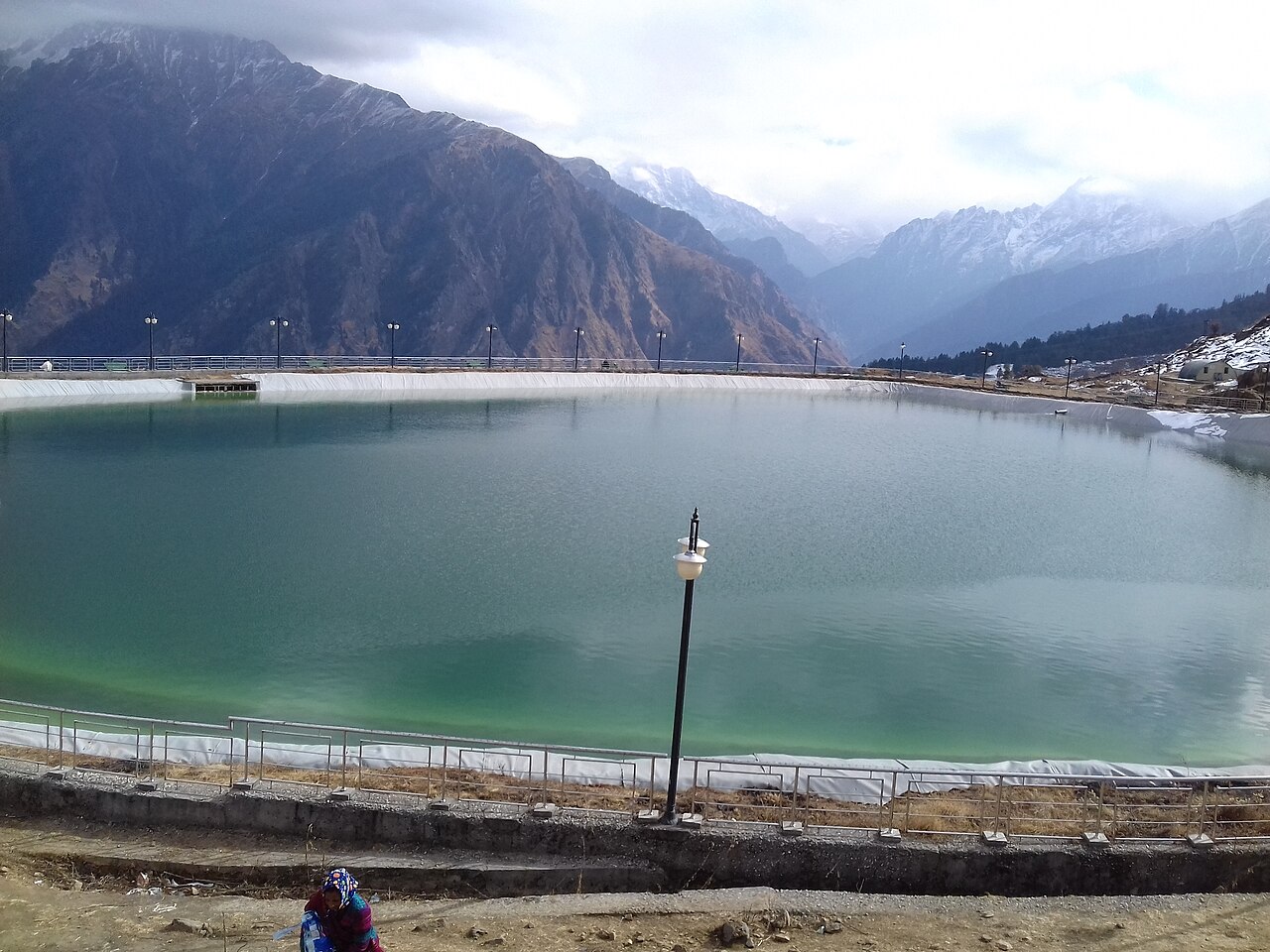
Auli is a stretch of open meadow and ski slope in Chamoli district, high above the Alaknanda valley, which the Chamoli district gives as running from 2,500 m to 3,050 m. It sits 12.3 km by road above Jyotirmath, the town on the Badrinath highway whose name was officially changed from Joshimath in 2024, and on a clear day it looks straight across the valley at Nanda Devi and the peaks around it. There is no old town at Auli: it is GMVN’s resort and huts, a handful of private hotels, the ski slopes, the chairlift and the artificial lake built to feed the snow-making system with forest below. Jyotirmath, at about 1,875 m, is where the shops and most of the rooms are.
The main run is the Nanda Devi slope, which the international ski federation, FIS, has recognised since 2010, a recognition that runs until 2029, ETV Bharat reported in January 2026. The district describes a run of about 3 km with a drop of 500 m. ETV Bharat calls Auli the only winter sports destination in Uttarakhand, which is why national championships are held here and why the trip only makes full sense when there is snow on the ground. Our Uttarakhand in winter guide covers the gentler hill towns for a trip without snow.
The high peaks around Auli get snow from September or October, but snow that lies on the slopes themselves comes later, and its timing has swung widely. In the last three winters the first proper fall on the slopes came on these dates, all from local news reports, which our guide to where to see snow in Uttarakhand sets out place by place.
| Winter | First snow on the slopes | What followed |
|---|---|---|
| 2023-24 | 17 to 18 January 2024 | A dry December across Uttarakhand. More snow across the hills on 31 January. |
| 2024-25 | 8 to 9 December 2024 | Heavy snow again on the night of 23 December. The national winter games set for 29 January 2025 were still put off for lack of snow on the race slope. Snow on 28 February, and Auli was cleared of tourists for a day on 3 March under an avalanche alert. |
| 2025-26 | 23 January 2026, more than a foot | More on 27 and 29 January. By 5 February the snow was melting fast, and the national championship from 13 to 16 February used two slopes, with snow carried in where it was thin. Fresh snow on 16 March and again in early April. |
So the pattern is a first fall anywhere from early December to late January, the best cover in late January and February, and late snow into March. The Chamoli district’s tourism page, last updated in 2018, still speaks of snow about 3 m deep from January to March; recent winters have been far thinner than that, and the race organisers measured about a foot of packed snow in late January 2026. Nobody can promise snow for dates you book in October, so if snow is the point of the trip, keep your plans flexible and book late.
December. In one of the last three Decembers, 2024, Auli had good snow, and in the other two it had none worth the name. The photo below was taken on 18 December 2016, with the slopes brown and the snow still on the far peaks, which is what a December trip often finds. The days are mild for the height, and the week from Christmas to New Year is the busiest of the season: after the snow of 23 December 2024 almost every hotel and resort in Auli, GMVN’s huts included, was full until 2 January.

January. The month with the best record: there was snow on the slopes in January in all three of the last winters, though in 2026 only from the 23rd. It is also the coldest month, and the month the road is most likely to ice up. On 25 January 2026, two days after the first snow, police stopped tourist vehicles at the TV Tower bend and let only four-wheel drives and local vehicles further up, and the queues stretched back towards Sunil.
February. Usually the deepest snow and the month the race organisers prefer, since they say March is too warm. It is not certain, though: the snow of late January 2026 was already melting fast by 5 February. If you are going for a ski course, February is the month to aim for.
March. Longer, warmer days and fresh snow most years, falling on 28 February 2025 and on 16 March 2026, with more in early April 2026. Old snow goes soft and patchy on the lower slopes by the middle of the month. Late snow also brings avalanche warnings: on 3 March 2025, after an avalanche at Mana up the valley, tourists were sent out of Auli for a day until the alert was lifted.
There is no official weather station at Auli, and the temperatures quoted on travel sites disagree. For a fair picture we took three winters of daily data, from November 2023 to March 2026, from Open-Meteo’s historical weather service, which works from a weather model, not a thermometer on the slope, for a point at 2,800 m above Auli and for Jyotirmath at 1,875 m, and averaged them month by month. Treat the numbers as a guide to how cold it gets, not as a forecast. They match what reporters found: Amar Ujala gave Auli a high of 9°C and a low of minus 2°C on 11 December 2023.
| Month | Auli slopes, day / night | Coldest night in the three winters | Jyotirmath, day / night |
|---|---|---|---|
| November | 12°C / 0°C | −4°C | 18°C / 6°C |
| December | 10°C / −4°C | −13°C | 16°C / 3°C |
| January | 7°C / −8°C | −16°C | 14°C / 0°C |
| February | 6°C / −9°C | −16°C | 14°C / 0°C |
| March | 10°C / −4°C | −14°C | 18°C / 4°C |
What the table means on the ground: from December to February the slopes are below freezing every night, and a sunny afternoon feels far warmer than the number while a cloudy one feels colder, because the wind across the open meadow does most of the work. The artificial lake freezes too, as it did after the January 2026 snow. Pack thermal layers, a down jacket, waterproof gloves, a warm cap and shoes with a grip, and plan to be indoors by sunset.
Two different lifts get mixed up in what you read about Auli. The ropeway is the cable car from Jyotirmath up to Auli, about 4 km long on ten towers, which GMVN opened in 1993 and which was for years the easy way up. It stopped on the orders of the district administration in early January 2023, when land subsidence opened cracks in hundreds of buildings in Joshimath and the ground near its first tower moved. In January 2024 the state’s disaster management secretary told Amar Ujala that every tower would have to be replaced and realigned before it could run again, and in June 2026 it was still shut, with traders in Auli saying the closure was costing them heavily. We found no restart date. Some travel and booking sites still list ropeway tickets and timings; they are out of date.
The chairlift is GMVN’s lift on the slopes at Auli itself, and it is what most visitors ride now. It has run in each of the last two winters. More than 600 people rode it on Christmas Day 2024, its in-charge told Amar Ujala; ETV Bharat put the figure at about 600 a day in mid-January 2025; and on 25 January 2026 its manager counted more than 1,200. It was stopped with the rest of Auli during the avalanche alert of March 2025 and ran again on 4 March. We could not find chairlift fares or hours published by GMVN, and the figures on travel sites do not agree, so ask at the counter on the day.

GMVN runs beginners’ ski courses at Auli from January to March, when there is snow. On its own skiing page for the 2025-26 season, a seven-day course without a certificate cost Rs 19,900 with a dormitory bed and Indian meals or Rs 10,000 without, and a fourteen-day certificate course Rs 39,000 or Rs 19,000, all including GST, for Indian adults. The fee covers skis, boots, poles, the ski lifts and the training. Half is paid in advance, and if GMVN cancels a course for lack of snow it keeps 10 per cent of that advance, which tells you how often snow has been the problem. Private ski schools in Auli run their own courses at their own prices.
Auli does have equipment for making snow, but it does not work. A European snow-making system was installed for the South Asian Winter Games of 2010-11 at a cost of about Rs 6.5 crore, with the artificial lake built to feed it, and ETV Bharat reported in January 2025 that it had never covered the slopes. In January 2026 residents began a “Save Auli” protest, demanding that the rusting machines and an ice-skating rink built for about Rs 5 crore be put to use. Until that changes, skiing at Auli depends on what falls from the sky: four national winter games and two international races have been lost to poor snow, ETV Bharat counted.
Staying up at Auli means waking on the snow, catching the peaks at sunrise and keeping off the icy road in the morning rush. The choice is small, though: GMVN’s resort and huts and a few private hotels, which fill first in a snowy week and over Christmas and New Year. Jyotirmath, 33 minutes below by Google Maps, has far more hotels, homestays and places to eat, usually for less. The catch is the road up after fresh snow, when traffic can sit for hours near Sunil, the TV Tower and Kichad Band, and only four-wheel drives may be let through. A night or two in Jyotirmath also makes Auli easy to combine with the winter seats of Badrinath at the Narsingh temple in Jyotirmath and at Pandukeshwar, which our guide to the Char Dham yatra in winter covers. Jyotirmath is still living with the land subsidence of 2023, so check the district’s advisories before you book there.
Auli is a long way from anywhere, and in winter the drive matters as much as the snow. We measured these on Google Maps on 27 October 2026, with usual traffic and no stops.
| From | Distance | Drive without stops | Way |
|---|---|---|---|
| Haldwani bus stand | 308 km | 10 h 31 min | Bhowali, Dwarahat, Chaukhutia, Karnaprayag, Chamoli, Jyotirmath |
| Kathgodam | 303 km | 10 h 20 min | The same road |
| Delhi (India Gate) | 491 km | 11 h 52 min | Meerut, Haridwar, Rishikesh, Rudraprayag, Karnaprayag on NH 7 |
| Jyotirmath (Narsingh temple) | 12.3 km | 33 min | The Auli road |
With winter daylight from about seven in the morning to half past five in the evening, none of the long drives fits into one day of light, so plan a night on the way, at Karnaprayag on the Kumaon road or at Rudraprayag on the Rishikesh road. From Delhi by train, the Ranikhet Express reaches Kathgodam at 05:05, which leaves a full day to get as far as Karnaprayag; our Delhi to Kathgodam train guide has the timetable and this winter’s fog cancellations. From the Garhwal side, trains run to Haridwar, Rishikesh and Dehradun, and the road climbs from there. A taxi from Haldwani is the easier choice over driving yourself in snow; our Haldwani cab guide lists operators. Bus and train times, and every route in more detail, are in our guide to getting to Auli.
Three checks are worth making the day before you set out and again each morning. First, the forecast: the India Meteorological Department’s centre in Dehradun publishes a seven-day forecast and colour-coded warnings for Chamoli district, and a warning of snow above 2,500 m means Auli. Second, the road: after fresh snow ask your hotel or the police in Jyotirmath whether the Auli road is open to ordinary cars or only to four-wheel drives beyond the TV Tower, and set off early, before the queue forms. Third, avalanche alerts, which follow heavy late-winter snow and closed Auli to visitors for a day in March 2025. Drive only in daylight and be at your night’s stop by about 4 PM, because shaded bends freeze once the sun goes.
If the snow does not come, Auli is still worth the trip for the views and the walk up through the forest, and the Kuari Pass trek starts from Dhak or Karchi, near Jyotirmath; our winter treks guide covers it and this winter’s trekking rules. For the rest of the season, from the hill towns that stay open to the festivals worth timing a trip around, go back to our Uttarakhand in winter guide.
The first snow on the slopes usually falls between early December and late January, and more comes through February and into March. The first fall came on 17 January 2024, on 8 December 2024 and on 23 January 2026, so the start can move by six weeks from one winter to the next. The high peaks above Auli get snow much earlier; this season they had it on 9 October 2026.
Cold, though not the coldest month. Averaged over the last three Decembers from modelled weather data, days on the slopes reach about 10°C and nights fall to about minus 4°C, and the coldest December night in those winters was about minus 13°C. Jyotirmath, about 900 m lower, averages about 16°C by day and 3°C at night.
No. The ropeway from Jyotirmath (Joshimath) to Auli has been shut since January 2023, when land subsidence in the town moved the ground near its towers, and it was still shut when we checked on 27 October 2026, with no restart date announced. The GMVN chairlift on the Auli slopes is a separate lift; it ran last winter, and more than 1,200 people rode it on 25 January 2026.
January, if you want snow. In each of the last three winters there was snow on the slopes in January, but in December only once, in 2024. December is milder, and the week from Christmas to New Year is the busiest of the season: in 2024 almost every hotel in Auli was full until 2 January.
By road. It is 308 km from the Haldwani bus stand on Google Maps, about ten and a half hours without stops, through Bhowali, Dwarahat, Chaukhutia and Karnaprayag to Jyotirmath, then 12 km up the Auli road. In winter daylight that means two days, with a night at Karnaprayag or Jyotirmath. The ropeway from Jyotirmath is shut, so the last stretch is by road too.